Employment equity reports, from a payroll file to sign-off.
An employment equity consultancy was rebuilding EEA2 workforce profiles and EEA4 income-differential schedules by hand, client by client, from payroll extracts. Findings had to be cited against the Act and the current equity plan. A missed occupational level or a headcount that did not foot to the file would be discovered late, usually in a review meeting.
A workbench that turns a payroll file into a sign-off pack a consultant can defend.
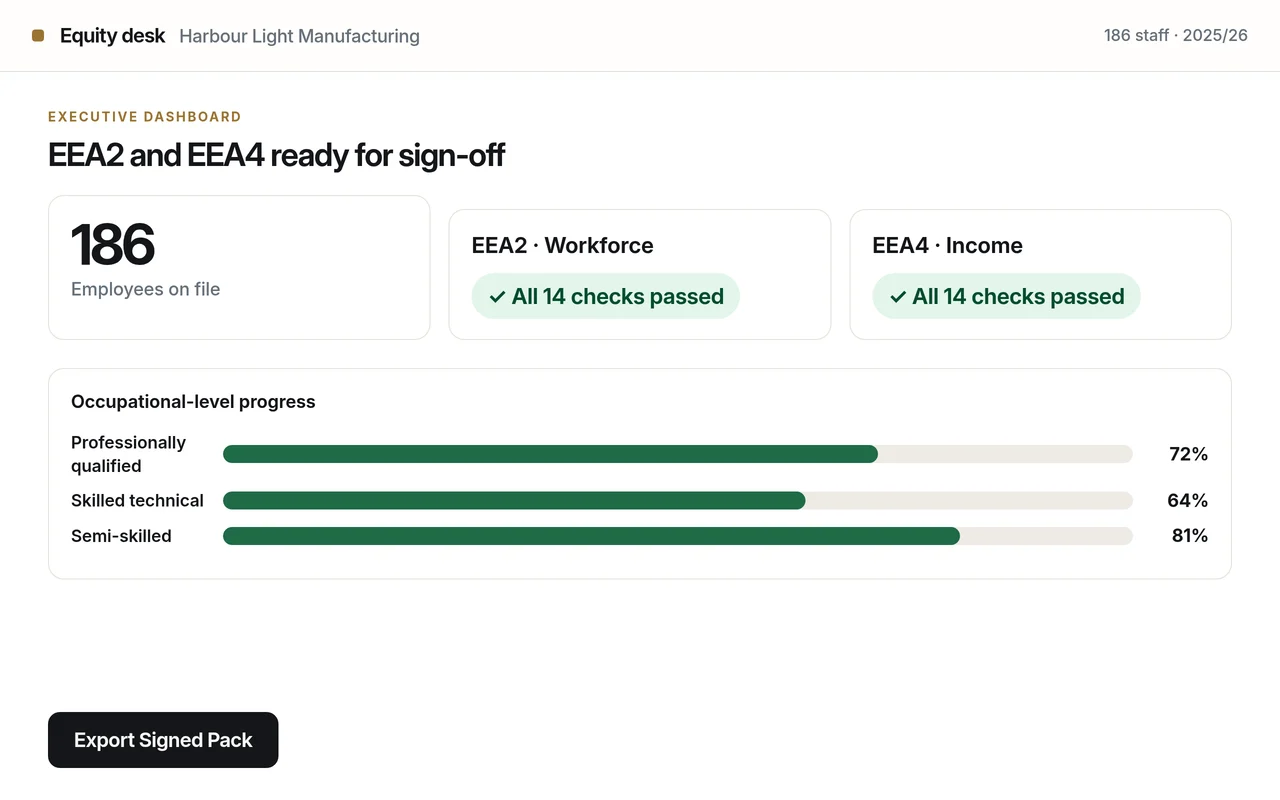
- Payroll in, EEA2 and EEA4 out. Occupational levels, temporary staff and income differentials are tallied from the file, not retyped into a spreadsheet.
- Findings with citations. Under-representation, disability-target gaps and income-differential narratives are produced by regulations encoded as tests, not by a free-text prompt.
- A plan that knows what year it is on. Year-3 of a five-year plan is a first-class fact, so a finding is framed against the current target, not a generic benchmark.
- Human sign-off, then SharePoint. Nothing is filed or sent until a consultant reviews the pack. The signed artefact can be dropped into the firm's existing document library.
The regulations have to be right, and they have to be testable. A model that “summarises the Act” is not enough when a figure has to foot to the payroll file and a finding has to point at a specific test. Identity and PAYE fields stay in the consultancy's workspace; the workbench shows the profile and the findings, not the raw employee file.
Packs that used to take days now assemble from a payroll file, with every finding cited, and a consultant still signs them before they leave the building.