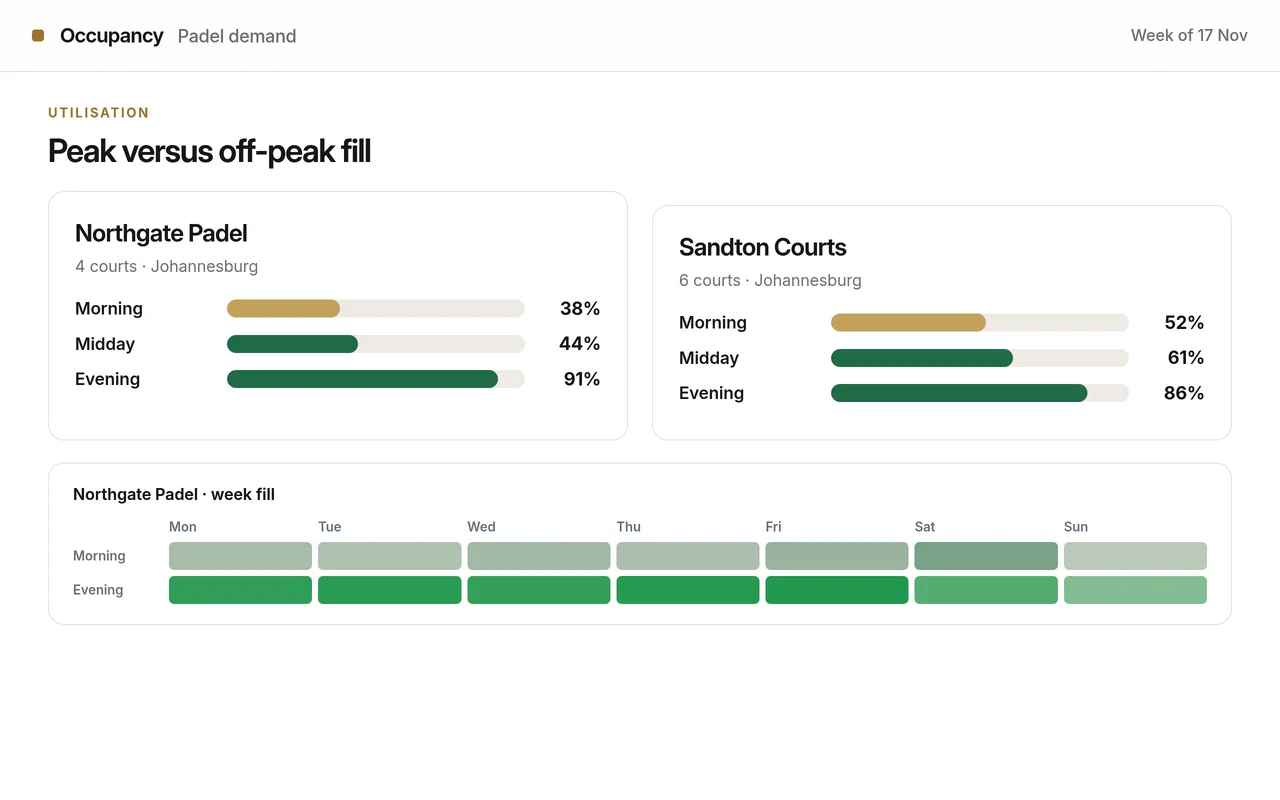
Court occupancy intelligence
Not where the clubs are, how full they actually get.
Deciding where to open a padel venue, or what to charge, needs demand data. Club directories tell you where courts exist. They do not tell you whether anyone is booking them, and no platform publishes utilisation.
Discovers every club in a target country along with its courts, amenities and opening hours, then snapshots bookable availability twice a day across a rolling window, each club in its own local calendar, which matters across a country spanning multiple timezones.
- Availability is not occupancy. Platforms advertise bookable slots at their real durations, 60, 90 and 120 minutes, often several overlapping at the same start time. Counting them gives a meaningless number.
- Normalised into fixed cells. Each court-day is normalised into fixed cells across the club's operating hours, producing an occupancy figure that is comparable between clubs, cities and weekdays.
- Two snapshots a day. A morning reading before play starts and a later one capture how a day fills, which is the difference between "this club is busy" and "this club sells out on Tuesday evenings".
The platform's API began returning 403 Request blocked to all ordinary clients, with or without a proxy. Rather than escalating an arms race, the collector was rebuilt to read the same data the way the public website does. The pipeline kept running; the dead module is still in the tree, documented, so nobody rediscovers the problem.