Email and deal intelligence
Years of inbox, turned into something the firm can query.
An advisory firm's real knowledge, who introduced whom, what was agreed, which deal a valuation belongs to, lives in individual inboxes. It is invisible to everyone else and it leaves when the advisor does. But mail is also the most access-sensitive asset the firm holds, so "just index it" is not an option.
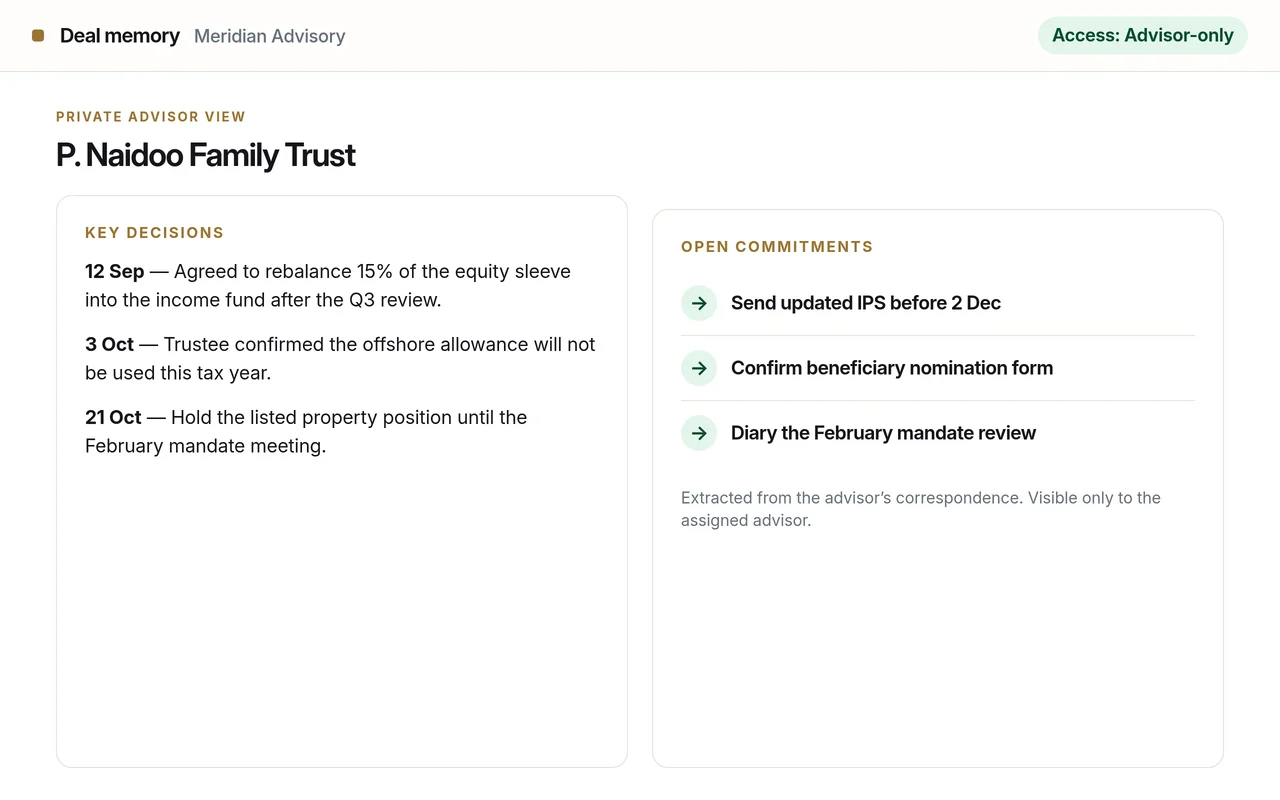
Extracts entities and relationships from years of correspondence, resolves which mentions refer to the same client, deal or product, and holds the result as a knowledge graph rather than a pile of embeddings. Compliance packs are generated from the same source of truth.
Deals are re-detected from scratch on every processing cycle, so any wobble in a computed key used to spawn a duplicate card. A registry now maps each deal to a stable canonical identity that survives across cycles.
Similarity alone cannot do this. Two different clients who share a surname produce nearly identical text, no similarity threshold separates them. Structure does: different advisor, different account, no shared email thread. The graph gives an answer with a reason attached, which is what a compliance reviewer actually needs.
Institutional memory becomes searchable across the firm without widening who can see what: access is enforced per advisor, so each user queries only their own book, and the model cannot be talked into exceeding that scope.